What is karst?
 |
| El Torcal (Antequera - Spain) |
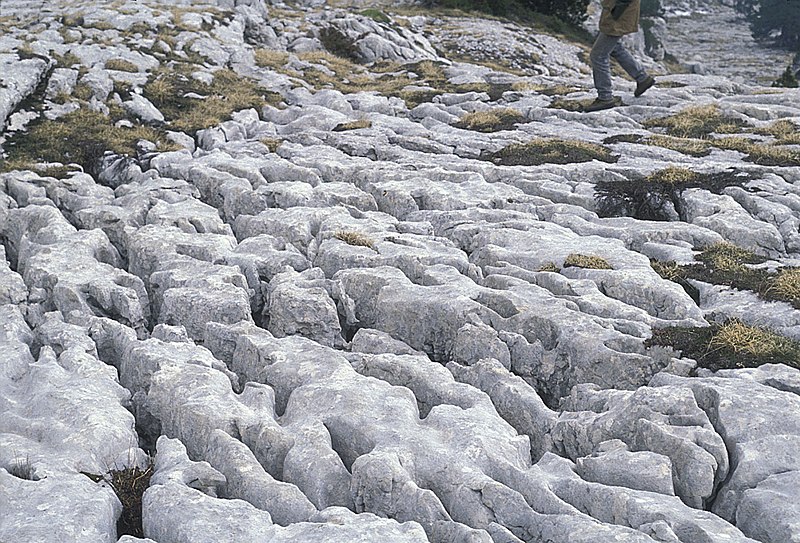 |
| Limestone pavement in Dent de Crolles, France |
When did karst start?

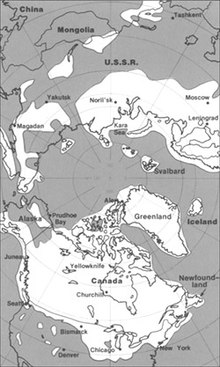 |
| The maximum extent of glacial ice in the north polar area during Pleistocene time. |
Where is karst?
Karst is found in Africa, Europe, North and South America, Asia, and Oceania (Australia, new Zealand, and Papua new guinea)
Here in Japan, the most famous karst spots are:
 |
| Karst pinnacles at Akiyoshidai |
- Akiyoshi Plateau,
- Atetsudai and Taishakudai Plateaus
- Shikoku Karst
- Hiraodai Plateau
- and Okinoerabujima Island
But the karst here in Okinawa is not the same as it is in other places. In other places karst makes bridges, caves, ravines, and there’s even a lake in Italy that’s made by a karst sinkhole. But in Okinawa, it mostly looks like bowls in the ground. At this spot on the beach though, you can see at least three different types of karst: Caving, Horizontal Tubing, and Vertical Tubing. The karst here is made by rain coming down from the sky and mixing with the red clay and then running down the hill to the shore.
How is karst formed?

The main way karst happens is when rainwater combines with carbon dioxide (CO2) and makes carbonic acid (H2O+CO2=H2CO3… this is where we get the term “acid rain”.) When it hits the ground and mixes with the CO2 from the dirt (or in this case, red clay,) it gets even more powerful. When the acidic rain water gets to the limestone, it settles in the cracks or dips in the rock and begins to eat away at the rock creating these bowl shaped hole formations in the limestone.
The chemical reaction taking place between the carbonic acid and the limestone is like this:
H2O (water) + CO2 (carbon dioxide) → H2CO3 (carbonic acid)
CaCO3 (calcium carbonate) → Ca2+ (calcium)+ CO32– (carbonate)
CO32– (carbonate)+ H2CO3 (Carbonic Acid) → 2 HCO3– (bicarbonate)
CaCO3 (calcium carbonate)+ H2CO3 (carbonic acid) → Ca2+ (calcium)+ 2 HCO3– (bicarbonate)
 |
| Tidal Karst on Okinawa |
So here's the cache part... To successfully log this cache you need to complete a few scientific measurements.
1: Near where you parked, you will see this locally famous karst which shows horizontal tubing. Measure the width and length and calculate the approximate volume of rock removed from this example from karst (volume of a cylinder is v= π r2h).


2: Travel to this spot on the beach to see a good example of vertical tubing. Find this tube I'm in and measure the diameter and height.


3: Travel to this spot on the beach to see a really good example of what "Bedding Plane" means and to see the caving that happens when water gets inbetween these layers of rock. Go to the spot where you see me measuring, and measure for yourself the height to the bottom of the caving, the height to the top, and just to double check your answers, the height of the caving itself (the height of the cave + the height to the bottom should equal near the height to the top of the caving.)


4: Finally, take a picture of your favorite karst feature on this beach. Mine is the one where the rock looks like the head of a moray eel sticking out of the side of the cliff. Here's pictures with and without my head in his mouth:

 Mr. Hoku was nice enough to join us while we were out today. Here's him inside a vertical tubing looking out through some caving.

1: Near where you parked, you will see this locally famous karst which shows horizontal tubing. Measure the width and length and calculate the approximate volume of rock removed from this example from karst (volume of a cylinder is v= π r2h).


2: Travel to this spot on the beach to see a good example of vertical tubing. Find this tube I'm in and measure the diameter and height.


3: Travel to this spot on the beach to see a really good example of what "Bedding Plane" means and to see the caving that happens when water gets inbetween these layers of rock. Go to the spot where you see me measuring, and measure for yourself the height to the bottom of the caving, the height to the top, and just to double check your answers, the height of the caving itself (the height of the cave + the height to the bottom should equal near the height to the top of the caving.)


4: Finally, take a picture of your favorite karst feature on this beach. Mine is the one where the rock looks like the head of a moray eel sticking out of the side of the cliff. Here's pictures with and without my head in his mouth:


No comments:
Post a Comment